
Balloon decoration, floristry, lighting and event decoration compared: what works best when?

Anyone planning an event, a wedding, a company anniversary, a gala, a new opening or a high-end event will at some point face the same question: which decoration creates the strongest impact?
The options often include floristry, lighting, classic event decoration, printed elements, furniture, branding, fabrics, backdrops and balloon installations. At first glance, many of these elements serve a similar purpose. They are meant to make a space more beautiful, enhance an event and give the occasion a visual frame.
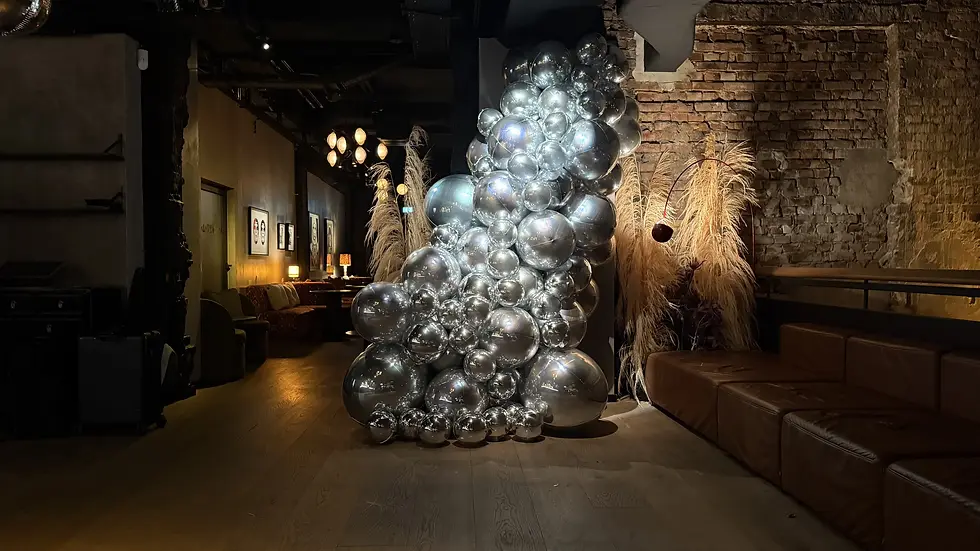
In practice, however, these design tools work very differently. Some create atmosphere mainly up close, others work particularly well in the dark. Some convey brand messages clearly but look flat. Others transform a space strongly but are logistically complex or require a lot of technology.
The decisive question is therefore not which element is better in principle. The better question is: what should be achieved, and which design tool fulfils this task most effectively?
The most important differences at a glance
Criterion | Balloons | Floristry | Lighting | Print & branding | Classic event decoration |
Visibility from a distance | Very strong | Limited | Depends on surroundings | Strong | Partly |
Impact up close | Strong | Very strong | Partly | Partly | Strong |
Three-dimensional spatial impact | Very strong | Partly | Strong, but not physical | Limited | Partly |
Emotional impact | Very strong | Very strong | Strong | Limited | Partly |
Photo spot potential | Very strong | Partly | Supporting | Strong with backdrops | Partly |
Showing brand colours spatially | Very strong | Limited | Partly | Very strong, but flat | Partly |
Quick transformation of a space | Very strong | Partly | Strong | Limited | Partly |
Impact in daylight | Very strong | Strong | Limited | Strong | Strong |
Impact in the dark | Strong | Partly | Very strong | Partly | Partly |
Use at new openings | Very strong | Partly | Partly | Strong | Partly |
Use at corporate events | Very strong | Strong | Very strong | Strong | Strong |
Use at hotels and galas | Strong | Very strong | Very strong | Partly | Strong |
Impact in shop windows and retail | Very strong | Partly | Limited | Strong | Partly |
Naturalness and detail | Partly | Very strong | Limited | Limited | Partly |
Technical effort | Medium | Medium | High | Medium | Medium to high |
Logistical effort | Medium | Medium to high | High | Medium | High |
Flexibility in shape and size | Very strong | Limited | Partly | Limited | Partly |
Temporary use for events | Very strong | Strong | Strong | Strong | Strong |
Recognisability in photos | Very strong | Strong | Partly | Very strong | Partly |
Filling space without massive structures | Very strong | Limited | Partly | Limited | Partly |
Combination with other elements | Very strong | Very strong | Very strong | Very strong | Very strong |
This overview already shows that no design element is automatically superior in every category. Floristry is extremely strong when it comes to naturalness, elegance and detail. Lighting is almost irreplaceable when mood, depth and atmosphere are to be created. Print and branding elements are important when a brand needs to be clearly visible.
Balloon installations are strongest where volume, colour, visibility and spatial impact are required. That is exactly why they work particularly well for entrance areas, new openings, shop windows, corporate events, trade fairs and large photo spots.
The strongest concepts, however, rarely come from a single element. The most high-end effect often arises from the combination of balloons, floristry, light and branding.
Floristry looks high-end, but often only up close
Floristry is one of the classic elements of high-end event design. Flowers look elegant, natural, emotional and detailed. Especially at weddings, galas, dinners, hotels and exclusive events, floristry can have a very strong effect. It brings nature, finesse and a certain elegance into the space.
The great advantage of floristry lies in its detail. A well-designed arrangement on a table, a high-end reception area with floral accents or a lavish flower installation can look very luxurious. For table design, close-up impact and elegant details in particular, floristry is hard to replace.
At the same time, floristry has a clear limit. It often has less impact from a distance. A large venue, a wide entrance area, a shop window or a trade fair floor often needs more volume than floristry can deliver economically. Anyone wanting to fill large areas with flowers quickly reaches very high budgets. In addition, fresh flowers are perishable, sensitive and often only keep their full quality for a short time.
Floristry is therefore strong when it comes to elegance, naturalness and details. However, it is not always the best tool when an area needs to be made visible on a large scale, an entrance marked from a distance or a space transformed with a lot of volume.
Lighting creates mood, but depends heavily on the surroundings
Lighting is one of the most effective ways to create atmosphere. Good lighting can transform a space completely. It can emphasise architecture, intensify colours, create depth, highlight stages and make an event look more high-end.
At evening events, galas, company parties, product presentations and events in darker rooms in particular, lighting is extremely strong. A room that looks rather plain during the day can suddenly appear warm, dramatic, elegant or spectacular thanks to light.
The disadvantage is that lighting depends heavily on the surroundings. In daylight, in bright rooms, in front of shop windows or outdoors, light often loses much of its effect. In addition, lighting needs power, technology, planning, positioning and sometimes extra coordination with the venue, technical service providers or fire safety regulations.
Light is an amplifier. It can dramatically improve an existing design. But light alone rarely creates a physical anchor in the space. It illuminates, emphasises and changes perception, but it does not automatically give guests something tangible to stand in front of, interact with or use as a photo spot.
Classic event decoration structures spaces, but quickly looks interchangeable
Classic event decoration covers many elements. Furniture, fabrics, carpets, backdrops, platforms, room dividers, vases, candles, signs, displays, banners, stands or decorative objects. These elements can be very important, especially when a space needs to be structured or divided functionally.
The advantage of classic event decoration lies in its versatility. Furniture creates lounge areas, fabrics change the feel of a space, backdrops create backgrounds, displays convey information and branding elements make a brand visible. That is why event agencies often work with a combination of many of these components.
The weakness lies in their interchangeability. Many classic decorative elements are seen at events again and again. Lounge furniture, roll-ups, photo walls, poseur tables, candles and fabric drapes can work, but quickly look like standard equipment if there is no clear concept behind them.
In addition, classic event decoration is often logistically complex. Furniture has to be transported, set up, collected, cleaned and stored. Large structural elements need space, staff and time. For some events this makes sense. For other projects it creates a lot of effort without a correspondingly strong visual impact.
Printed elements and branding are clear, but often flat
Banners, logos, backdrops, wraps, posters and printed elements have an important task. They convey a message very clearly. Especially at corporate events, trade fairs, product launches and retail promotions, they are often necessary because brands have to appear visibly and understandably.
The advantage lies in their clarity. A logo is a logo. A message is legible. A brand name becomes visible. This is important, especially when photos are later to be clearly attributed to a company, a campaign or an occasion.
The disadvantage is their flat effect. Printed elements mostly remain two-dimensional. They inform, but they only change the space to a limited extent. A banner can be visible, but it rarely creates atmosphere. A backdrop can work as a photo background, but without additional design it often looks technical or promotional.
Branding is therefore important, but rarely enough. A brand should not just be read. Ideally, it should be experienced spatially. This is exactly where other elements come into play.
Balloon installations bring volume, colour and spatial impact
Balloon installations have a special advantage. They create a lot of visible volume in a short time. They bring colour, shape, height, depth and spatial presence into a room without the need for heavy structures or permanent changes.
This sets them clearly apart from many other decorative elements. A balloon installation can frame an entrance, enhance a stage, make a shop window visible, fill an empty space or create a photo spot. It works not only up close, but often from a considerable distance.
Especially at new openings, corporate events, hotels, trade fairs, summer parties, anniversaries, weddings, galas and retail promotions, this presence is valuable. Balloons stand out without automatically seeming aggressive. They have positive emotional associations, are flexible to use and can be closely adapted to colours, brands, spaces and occasions.
Another advantage is their three-dimensionality. While banners and printed elements often remain flat, balloon installations work with real spatial depth. This creates a different impression. An area does not just look decorated, but staged.
Balloons can translate brand colours into space
Every company has brand colours. Some companies have a precisely defined corporate design with clear colour codes, fixed design rules and detailed guidelines. Others work less formally but still have a recognisable visual identity. At the latest through the logo, website, business stationery, social media, packaging or advertising material, colours emerge that are associated with a brand.
Even if a brand works mainly with black, white, grey or very muted tones, that is a design decision. Restraint is also part of a corporate identity.
In the digital space, these colours are usually a matter of course. They appear on websites, in presentations, ads, logos, newsletters or social media posts. In real space, however, it often becomes more difficult. A logo on the wall is rarely enough to create atmosphere. A banner can be visible, but quickly looks flat and promotional.
Balloons have a special advantage here. They bring brand colours into the space without immediately looking like classic advertising. They can pick up colours, intensify them and make them visible in three dimensions. A two-dimensional colour world becomes a spatial staging.
This is particularly relevant for retail, hotels, corporate events, trade fairs and product presentations. A brand is not just read, but experienced spatially. It is exactly this transition from graphics to space that is important for professional brand appearances.
Every form of event decoration has limits
It would be wrong to claim that a single form of decoration is always the best solution. Floristry has strengths, lighting has strengths, classic event decoration has strengths, branding has strengths and balloon installations have strengths.
The mistake happens when these elements are considered in isolation and played off against each other without taking the goal of the event into account.
Floristry can be beautiful, but not visible enough from a great distance. Lighting can be dramatic, but fizzle out in daylight or without strong spatial elements. Branding can be clear, but look too promotional without atmosphere. Furniture and props can structure spaces, but quickly become heavy, expensive or interchangeable. Balloons can create a strong impact, but need good design so that they do not look childish or arbitrary.
The best solution therefore does not come from the material alone. It comes from the interplay.
The strongest concepts combine several elements
At high-end events, it is rarely about using just one element. The strongest concepts often emerge when different design tools are deliberately combined.
Balloon installations provide volume, colour and spatial presence. Floristry brings naturalness, detail and elegance. Lighting enhances mood, shadow, shine and spatial depth. Branding connects the design with brand, occasion and message. Furniture, fabrics and other event elements structure the space and create a pleasant place to be.

It is precisely in this combination that a much more high-end effect is created. A balloon installation alone can already be strong. Combined with floristry, it often looks more refined and natural. With light, it gains more depth, shadow and drama. With clean branding, it becomes brand staging. With suitable furniture or a well-thought-out layout, it becomes a complete event concept.
That is the real premium approach. Not either balloons or flowers. Not either light or decoration. But the deliberate combination of the right elements.
Why balloons are particularly strong in combination
Balloons are particularly suitable as a basis for great visual impact because they bring volume and shape into the space. Floristry can refine this effect. Light can intensify it. Branding can make it unmistakable.
An organic balloon installation with floral elements often looks much more high-end than pure balloon decoration. It gains more texture, more naturalness and more detail. If this installation is also well lit, shadows, highlights and spatial depth emerge. The entire set-up thus looks more glamorous, complete and professional.
That is exactly why the combination of balloons, floristry and light is so strong. Balloons create the body of the installation. Floristry brings finesse and naturalness. Light adds depth and mood. Together they create a spatial staging that can do much more than any single element.
For weddings, galas, company anniversaries, hotels, luxury events, product launches and high-end event formats, this combination is particularly interesting. It does not look like simple decoration, but like a deliberately designed experience.
What matters is not the material, but the impact
In the end, the decision should not be whether balloons are better than flowers or light better than classic event decoration. That question is too simple. What matters is the impact a space or an occasion should have.
Should an entrance become visible? Then balloon installations can be very strong. Should a dinner look more high-end? Then floristry can be decisive. Should a gala appear more dramatic? Then lighting is often indispensable. Should a brand be clearly recognisable? Then branding is needed. Should a space look complete and high-end? Then a combination of several elements is often needed.
Professional event design consists precisely in not making these decisions at random. Good design does not first ask which material should be used. It first asks what impact should be created.
Conclusion
Floristry, lighting, classic event decoration, branding and balloon installations each have their own strengths. Floristry brings elegance and detail. Lighting creates mood and atmosphere. Branding creates recognition. Classic event decoration structures spaces. Balloon installations bring volume, colour, three-dimensionality and visible presence.
Each of these elements can work on its own. The strongest impact, however, often comes from the combination. Balloons in particular combine excellently with floristry, light and branding, because they quickly transform a space visibly while offering enough surface, shape and volume to integrate other elements.
That is why high-end event design is not about playing balloons off against flowers, light or other decorative elements. It is about finding the right interplay.
Because a strong event does not come from as many individual parts as possible.
It comes from a design that works as a whole.


Comments